






 Domicile
 Des produits
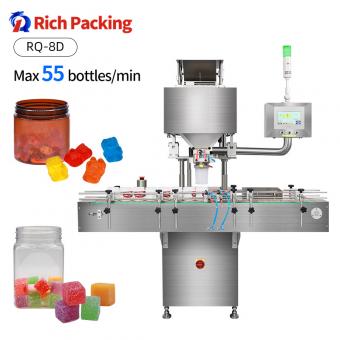
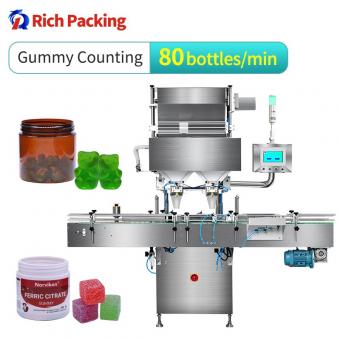
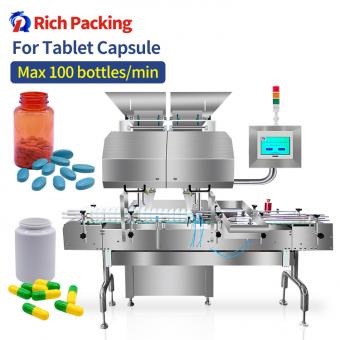
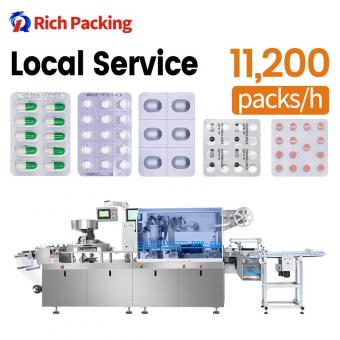
29+ years in pharmaceutical machinery, covering capsule filling, tablet pressing, blister packaging, tablet and capsule counting, cartoning, GMP production, and overseas machine service.

Vous bénéficiez d'un contrôle précis de la force de compression et des paramètres du procédé avec une machine de compression rotative pour comprimés pour les problèmes de plasticité des matériaux.
|
Fonctionnalité |
Description |
|
Contrôle précis du poids |
Un poids uniforme des comprimés réduit la variabilité. |
|
Construction robuste |
Des matériaux durables garantissent la fiabilité. |
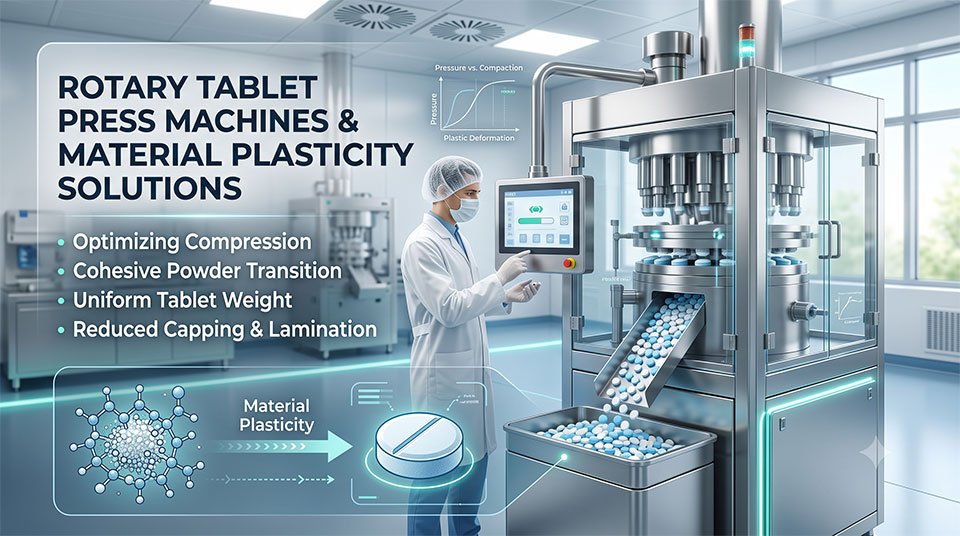
Lorsque vous utilisez une machine de compression rotative pour comprimés pour les problèmes de plasticité des matériaux, vous rencontrez souvent plusieurs défis récurrents. Ces problèmes peuvent perturber la production et compromettre la qualité des comprimés s'ils ne sont pas traités rapidement. Le tableau ci-dessous résume les défis les plus courants et leurs causes typiques :
|
Défi |
Causes courantes |
|
Collage (collage au poinçon) |
Humidité excessive, séchage inégal des granulés, lubrification insuffisante, proportion élevée de poudre fine, usure de l'outillage, humidité élevée. |
|
Séparation des couches (délamination) |
Force de tassement excessive, propriétés des matériaux incompatibles. |
|
Contamination croisée |
Gestion inadéquate de la poussière entraînant un transfert de poudre entre les couches. |
|
Poids de couche imprécis |
Mauvaises propriétés d'écoulement du matériau, problèmes avec le système de double alimentation. |
|
Décapsulation/Dureté insuffisante |
Emprisonnement d'air, compression finale mal optimisée. |
Vous pouvez également rencontrer des erreurs opérationnelles qui entraînent ces problèmes. Par exemple :
1. La décapsulation peut résulter d'un emprisonnement d'air ou d'une faible humidité. Vous pouvez l'éviter en optimisant les paramètres de compression et en maintenant des niveaux d'humidité appropriés.
2. La délamination se produit souvent en raison d'air emprisonné ou d'un liant faible. L'amélioration des techniques de granulation et de la qualité du liant aide à éviter ce problème.
3. Le collage au poinçon peut être causé par une lubrification excessive ou un polissage incorrect du poinçon. L'ajustement de la lubrification et l'entretien des surfaces des poinçons peuvent résoudre ce problème.
4. Le collage est généralement causé par une lubrification insuffisante ou une humidité élevée. Assurer une lubrification correcte et contrôler les conditions environnementales sont des solutions efficaces.
5. L'écaillage résulte d'une faible concentration de liant ou d'une faible résistance des granulés. L'augmentation de la concentration de liant et le renforcement des granulés peuvent prévenir ce problème.
6. Conseil : Une distribution uniforme de la taille des particules améliore le mélange et empêche la stratification de la poudre, ce qui réduit les différences de poids entre les comprimés.
Vous pouvez compter sur des mécanismes avancés dans une machine de compression rotative pour comprimés pour les problèmes de plasticité des matériaux. Ces machines offrent une surveillance en temps réel du serrage des poinçons, qui arrête automatiquement le système en cas d'écarts. Les systèmes de lubrification automatisés de qualité alimentaire garantissent une application constante, tandis que les modules optionnels de pulvérisation de stéarate de magnésium fournissent une lubrification précise pour les matériaux collants. Les revêtements d'outillage personnalisables vous aident à traiter des profils spécifiques d'adhérence.
Les capteurs et les systèmes de rétroaction jouent un rôle crucial dans la gestion de la plasticité des matériaux. Le tableau ci-dessous met en évidence comment ces fonctionnalités contribuentà un meilleur contrôle :
|
Fonctionnalité |
Contribution à la plasticité du matériau |
|
Capteurs de force de compression |
Surveillent et ajustent la force de compression en temps réel, garantissant un poids et une qualité uniformes des comprimés. |
|
Rouleaux de précompression |
Éliminent l'air entre la poudre et le moule, améliorant la plasticité et la qualité de la poudre des comprimés. |
Vous pouvez également bénéficier d'un profilage stratégique de la température et d'un contrôle statistique des processus. Ces méthodes vous permettent d'optimiser systématiquement les paramètres et d'établir des plages de traitement robustes. Ainsi, vous réduisez la formation de vides et améliorez la qualité du produit.
Lorsque vous utilisez une presse à comprimés rotative pour résoudre les problèmes de plasticité des matériaux, vous influencez directement à la fois la qualité des comprimés et l'efficacité de fabrication. Un contrôle efficace de la plasticité des matériaux améliore la coalescence des particules, ce qui entraîne des tailles de granulés uniformes et moins de défauts. Le tableau ci-dessous illustre l'impact sur l'efficacité et les taux de rejet des lots :
|
Aspect |
Impact sur l'efficacité de fabrication |
Impact sur les taux de rejet des lots |
|
Plasticité supérieure |
Améliore la coalescence des particules, conduisant à des tailles de granulés uniformes |
Réduit les défauts, diminuant ainsi les taux de rejet |
|
Déformation plastique optimisée |
Minimise la casse pendant le traitement |
Réduit la génération de fines et les taux de retraitement |
|
Contrôle approprié de la plasticité |
Améliore le débit et réduit les fractions hors calibre |
Augmente l'uniformité du produit, réduisant les rejets |
Vous constaterez qu'un contrôle approprié de la plasticité améliore le débit et réduit les fractions hors calibre. Cela conduit à une plus grande uniformité du produit et à moins de lots rejetés. Une distribution uniforme de la taille des particules joue également un rôle important. Les particules plus petites augmentent la surface et la force de liaison, ce qui renforce la résistance à la traction de vos comprimés. Un faible écart type de la taille des particules garantit un remplissage uniforme pendant la compression, réduisant les différences de poids et améliorant la régularité.
Remarque : En vous concentrant sur ces aspects, vous pouvez obtenir des rendements plus élevés, réduire les déchets et maintenir une qualité constante des comprimés tout au long de vos cycles de production.
Vous pouvez obtenir des résultats optimaux en ajustant la force de compression et les réglages de la machine sur votre presse à comprimés rotative pour résoudre les problèmes de plasticité des matériaux. Les matériaux à forte plasticité nécessitent des temps de séjour plus longs, permettant aux particules de se déformer et de se lier efficacement. Des temps de séjour plus courts conviennent aux matériaux hautement compressibles, empêchant la surcompression et maintenant l'intégrité des comprimés. Vous devez également optimiser la force de précompression afin d'améliorer le réarrangement des particules, ce qui réduit la force de compression principale nécessaire et améliore la qualité des comprimés.
Conseil : L'ajustement du temps de séjour et des réglages de précompression vous aide à adapter le processus de compactage aux caractéristiques spécifiques de plasticité de votre formulation.

La sélection du bon outillage et son entretien régulier garantissent une qualité constante des comprimés lors de l'utilisation d'une presse à comprimés rotative pour résoudre les problèmes de plasticité des matériaux. Vous devez nettoyer l'outillage après chaque lotpour éliminer les résidus et empêcher le collage. Une évaluation régulière de l'usure et des dommages permet de maintenir l'outillage dans un état optimal. L'application de lubrifiants appropriés empêche le grippage et réduit les frottements.
Vous pouvez optimiser la conception des comprimés afin de réduire le collage et l'arrachement. L'ajustement des spécifications de l'outillage, telles que la profondeur de cuvette et le profil, minimise la zone de contact avec la formulation. Le maintien de conditions appropriées de l'outillage, notamment un nettoyage et une inspection réguliers, favorise une production constante.
1.Évitez les profils de godets profonds ; choisissez des conceptions peu profondes ou plates.
2.Utilisez des styles de police simples pour le gaufrage afin de réduire le risque de prélèvement.
3.Mettez en œuvre des techniques de conicité dans la conception de l’outillage pour faciliter la libération de la poudre.
Des revêtements spécialisés comme le PTFE minimisent l’adhérence pendant la compression des comprimés, ce qui est essentiel pour la manipulation des matériaux collants. Les surfaces hautement polies réduisent la rugosité, diminuant ainsi la probabilité que le matériau adhère à l’outillage. Les revêtements avancés à faible friction améliorent davantage les performances de l’outillage lors du traitement de divers matériaux, y compris les plastiques.
|
Cause des défauts |
Actions correctives |
|
Les matrices usées ou rugueuses augmentent la friction |
Inspection et polissage réguliers des poinçons et des matrices |
|
Adhérence aux faces des poinçons |
Optimiser les réglages d’éjection ; les matrices coniques réduisent les contraintes |
|
Les poinçons concaves profonds concentrent les contraintes |
Ajuster la vitesse de compression et la force de précompression |
Remarque : Un entretien constant de l’outillage et l’utilisation de revêtements spécialisés aident à minimiser l’adhérence, le prélèvement et la friction, garantissant ainsi des comprimés de haute qualité.
Vous pouvez améliorer la plasticité des matériaux en modifiant votre procédé et en ajustant les formulations. La sélection du type de liant et d’excipient approprié améliore la compressibilité et les propriétés d’écoulement. Les liants naturels comme Starch 1500, la gomme d’acacia et la gélatine offrent une biocompatibilité et une rentabilité élevées. Les liants semi-synthétiques, tels que les dérivés de cellulose, fournissent une qualité stable et constante. Les liants synthétiques comme la Povidone et le Polyéthylène glycol offrent une excellente capacité de liaison et une bonne solubilité. Les liants pour compression directe, notamment la cellulose microcristalline et le phosphate dicalcique, garantissent une excellente compressibilité et un bon écoulement.
|
Type de liant |
Exemples |
Utilisation typique |
Caractéristiques clés |
|
Liants naturels |
Starch 1500, gomme d’acacia, gélatine |
Granulation humide, compression directe |
Peu coûteux, biocompatibles, qualité variable |
|
Liants semi-synthétiques |
Dérivés de cellulose (HPMC) |
Granulation humide, compression directe |
Qualité stable et constante, solubilité ajustable |
|
Liants synthétiques |
Povidone (PVP), PEG |
Granulation humide |
Excellente liaison, bonne solubilité, inertes avec les API |
|
Liants pour compression directe |
MCC, Starch 1500, DCP |
Compression directe |
Excellente compressibilité, bonnes propriétés d’écoulement |
Vous pouvez également modifier les techniques de granulation, ajuster les niveaux d’humidité et optimiser la distribution granulométrique. Ces ajustements vous aident à obtenir un mélange uniforme, à réduire la stratification de la poudre et à améliorer la résistance des comprimés.
Encadré : Le choix des excipients appropriés et la modification des paramètres du procédé améliorent directement la plasticité et réduisent les défauts de vos comprimés.

Vous pouvez appliquer ces solutions et ajustements à des scénarios réels pour obtenir de meilleurs résultats. Par exemple, vous pouvez rencontrer des problèmes d’adhérence avec des matériaux à forte plasticité. Le nettoyage de l’outillage après chaque lot et l’application de revêtements PTFE peuvent résoudre ce problème. L’ajustement du temps de séjour et de la force de précompression vous aide à gérer les matériaux nécessitant davantage de déformation des particules.
Vous pouvez optimiser la conception des comprimés en sélectionnant des profils de godets peu profonds et des styles de gaufrage simples. Ces choix réduisent les risques de prélèvement et de collage. Une maintenance régulière de l'outillage, comprenant l'inspection et le polissage, garantit une qualité constante des comprimés et minimise les frottements.
Vous pouvez également améliorer la formulation en choisissant des liants de compression directe comme la cellulose microcristalline. Cet excipient améliore la compressibilité et l'écoulement, ce qui permet d'obtenir des comprimés uniformes. La modification des techniques de granulation et des niveaux d'humidité favorise davantage une production constante.
Vous pouvez obtenir des comprimés de haute qualité et sans défaut en mettant en œuvre ces bonnes pratiques avec votre machine de compression rotative pour résoudre les problèmes de plasticité des matériaux.
Vous obtenez des solutions ciblées pour la plasticité des matériaux avec les machines de compression rotative pour comprimés.
|
Facteur |
Impact sur les taux de défauts et la qualité |
|
Stabilisation de la compression |
Moins de défauts, poids et dureté des comprimés constants |
|
Surveillance intelligente |
Ajustements plus rapides, opérations stables, efficacité accrue |
Des examens réguliers du processus vous aident à maintenir des normes élevées et à minimiser les défauts.
Vous décrivez la plasticité des matériaux comme la capacité des particules de poudre à se déformer et à se lier sous pression. Cette propriété affecte directement la résistance et la qualité des comprimés.
Vous nettoyez et polissez régulièrement l'outillage. Vous appliquez des revêtements spécialisés et ajustez la lubrification. Ces étapes aident à prévenir le collage et garantissent une éjection fluide des comprimés.
Vous surveillez la force de compression pour maintenir un poids et une dureté constants des comprimés. Les ajustements en temps réel vous aident à réduire les défauts et à améliorer l'efficacité globale de la production.
Références
1. "Le maintien d'une distribution uniforme de la taille des particules est essentiel pour un remplissage constant des matrices, un principe largement souligné par Powder & Bulk Solids experts."
2. "Comme l'indiquent les récents rapports de fabrication sur Pharmaceutical Technology, les presses rotatives avancées augmentent considérablement le rendement tout en réduisant les taux de rejet."
3. "La mise en œuvre d'une surveillance de la compression en temps réel est conforme aux directives de la FDA sur la technologie analytique des procédés (PAT) pour la fabrication de formes posologiques solides."
4. "Le respect des ISPE Good Practice Guides garantit que l'étalonnage des machines, l'inspection de l'outillage et les routines de nettoyage répondent aux strictes exigences réglementaires."

29+ years in pharmaceutical machinery, covering capsule filling, tablet pressing, blister packaging, tablet and capsule counting, cartoning, GMP production, and overseas machine service.

E-mail : manager@richpacking.cn
Building D, No. 226, Beishan Qiaotou Street, Haizhu District, Guangzhou City, Guangdong Province, China


 Réseau IPv6 pris en charge