






 Domicile
 Des produits
29+ years in pharmaceutical machinery, covering capsule filling, tablet pressing, blister packaging, tablet and capsule counting, cartoning, GMP production, and overseas machine service.

Envisagez-vous de fabriquer vous-même vos emballages blister au lieu de faire appel à un fournisseur d'emballage partenaire ?
Pour de nombreux fabricants de produits pharmaceutiques et de compléments alimentaires, passer de la sous-traitance à la fabrication en interne de plaquettes thermoformées est comparable au passage de la location d'un appartement à la construction de sa propre maison. Cela exige de solides connaissances et un équipement adapté. Que vous soyez une petite marque de compléments probiotiques cherchant à conditionner de petits lots ou un fabricant pharmaceutique en pleine croissance souhaitant atteindre une production à grande échelle, maîtriser la fabrication de plaquettes thermoformées est essentiel pour accroître votre rentabilité et accélérer la mise sur le marché de vos produits. Ce guide détaille les principes mécaniques, les matériaux et les méthodes d'entretien nécessaires à la fabrication de plaquettes thermoformées pour médicaments.
Points clés à retenir
● Un aperçu de plaquettes thermoformées pour médicaments : structure et types
● Les raisons pour lesquelles il est préférable de fabriquer soi-même ses médicaments sous blister.
● Instructions étape par étape sur le processus de fabrication des emballages blister : des matières premières aux machines de blisterage.
● Protocoles de maintenance pour maximiser la durée de vie des équipements.
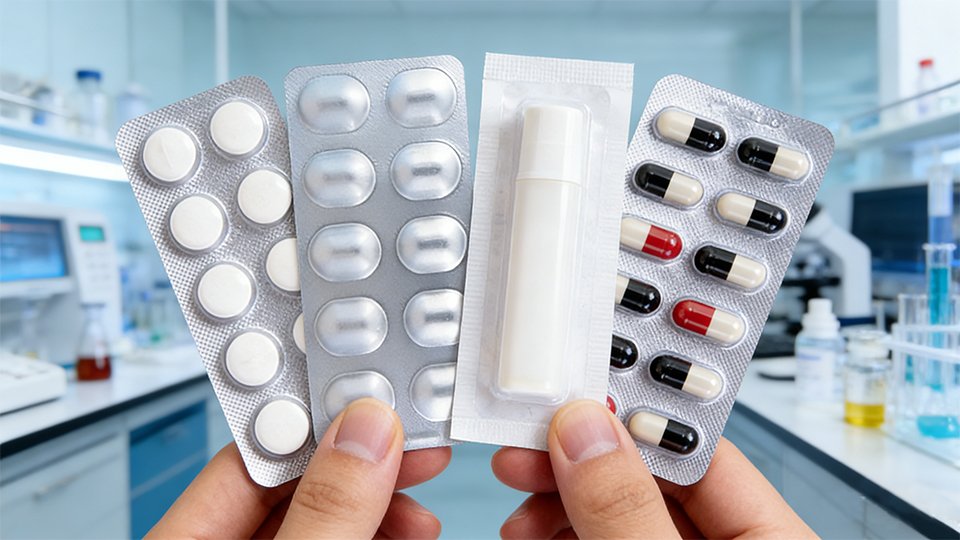
Avant d'aborder la méthode, il est essentiel de comprendre ce qu'est un emballage blister. Un blister pour médicaments est un type d'emballage couramment utilisé pour les doses unitaires, où les comprimés et les gélules sont conditionnés individuellement en quantités égales dans des alvéoles. Ce type d'emballage sert principalement à protéger les médicaments de l'humidité et de l'oxydation, garantissant ainsi leur efficacité et leur conservation.
Les plaquettes thermoformées sont omniprésentes dans notre vie. On les voit en pharmacie, dans les publicités télévisées ou sur internet. Le fait que ce produit, dont l'histoire remonte au milieu du XXe siècle, reste populaire à l'ère des progrès rapides de la médecine et des sciences prouve qu'il est bien plus qu'un simple emballage en plastique et en aluminium ; c'est un système de barrière soigneusement conçu pour garantir la stabilité des substances chimiques.
Pour simplifier, on peut diviser un emballage de médicaments sous blister en plusieurs couches. C'est comme un sandwich, où chaque couche a un rôle précis. Vous trouverez ci-dessous un aperçu de la structure d'un emballage de médicaments sous blister.
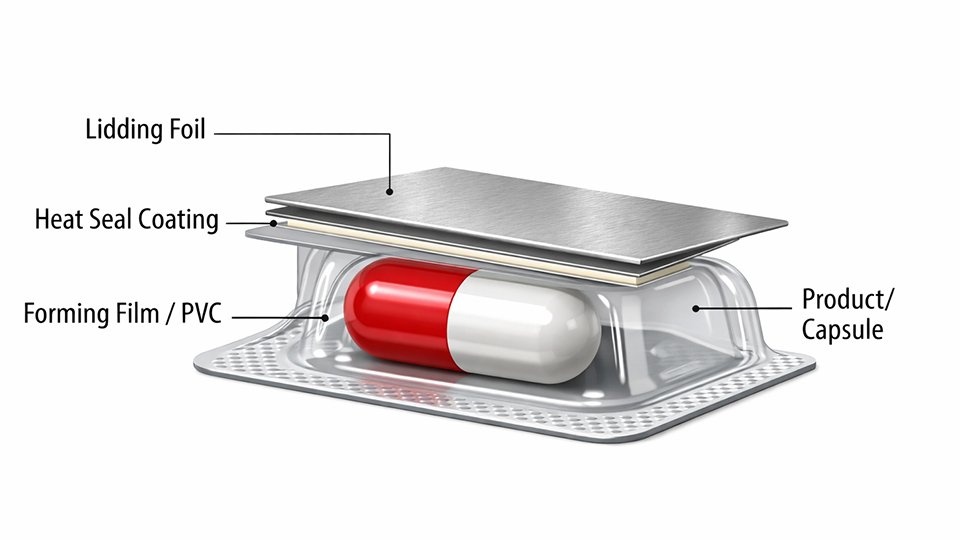
Matériau du couvercle : Il s'agit généralement de papier aluminium. C'est la couche « à traverser ».
Revêtement thermoscellable : Une couche collante qui lie le couvercle et la base.
Formation du film : La cavité contenant la pilule (PVC, PVDC ou Cold Form Alu).
Ensemble, ces couches forment une protection optimale pour les comprimés. Il est important de noter que chaque couche influe directement sur la qualité d'un emballage de médicaments sous blister. Par exemple, si le revêtement thermoscellé est trop épais, l'emballage devient impossible à ouvrir ; s'il est trop fin, le scellage ne protège pas efficacement les comprimés de l'humidité et de l'oxygène.
Saviez-vous que les plaquettes thermoformées pour médicaments ne sont pas toutes identiques ? En réalité, il existe trois types principaux : aluminium-PVC, aluminium-aluminium et papier-PVC. Le choix du type dépend entièrement de la sensibilité de votre médicament à l’environnement.
Alu-PVC : Le type le plus courant pour les gélules et les comprimés, grâce à son rapport qualité-prix avantageux. La bulle en plastique est chauffée et formée, permettant une visualisation claire du produit.
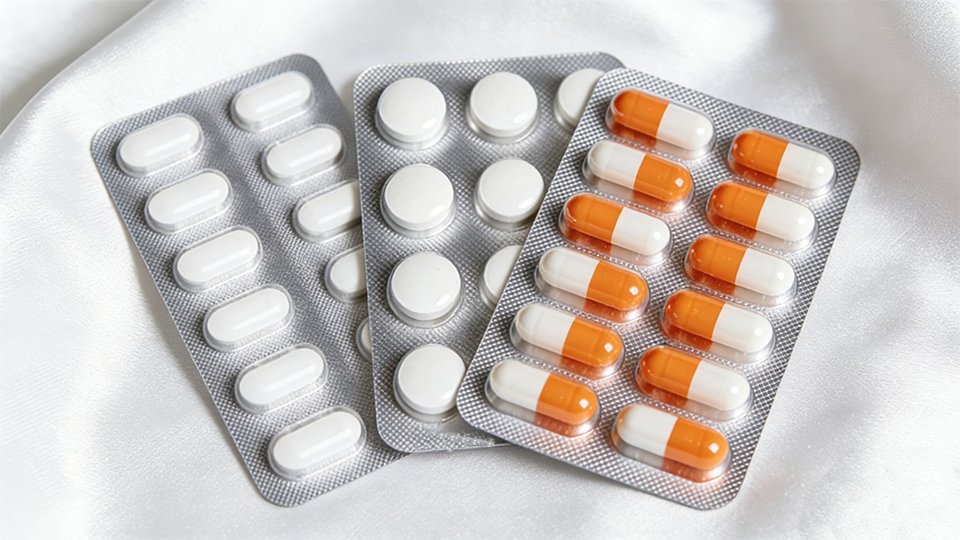
Alu-Alu : Contrairement à l'Alu-PVC, la couche inférieure est également en aluminium et les feuilles sont formées par moulage par compression plutôt que par thermoscellage. Ces matériaux confèrent à l'emballage blister une protection totale contre la lumière du soleil et l'humidité. Il est couramment utilisé pour le conditionnement de médicaments haut de gamme.
Papier-PVC : Souvent utilisé pour les emballages à l'épreuve des enfants. L'opercule est renforcé par du papier, ce qui le rend plus difficile à ouvrir et nécessite un mouvement de « décollage-poussée ».
La raison la plus simple est la maîtrise. Faire appel à des emballeurs tiers vous soumet à leur calendrier de production. Si leurs machines tombent en panne, le lancement de votre produit sera retardé. À l'inverse, fabriquer soi-même ses emballages blister offre une plus grande flexibilité pour le lancement du produit.
Le coût est également un facteur important. Bien que l'investissement initial en machines et équipements soit plus élevé, la fabrication artisanale de plaquettes thermoformées pour médicaments peut réduire considérablement les coûts de production à long terme. Une analyse des coûts dans le secteur pharmaceutique montre que les entreprises de conditionnement à façon facturent généralement des frais d'installation de 2 500 $ à 5 000 $ par lot, quelle que soit sa taille. Pour une petite commande de 5 000 plaquettes thermoformées, ces frais d'installation représentent à eux seuls un surcoût de 0,50 $ à 1 $. Et ces coûts n'incluent pas les matières premières ni la main-d'œuvre. En revanche, si vous apprenez à fabriquer vous-même vos plaquettes thermoformées, vous ne payez que les matières premières et l'électricité.
Voici le cœur de notre guide. La fabrication des blisters est une orchestration précise de la chaleur, du temps et de la pression.
Il existe de nombreux types de machines de conditionnement sous blister, notamment des modèles manuels, automatiques et de laboratoire. Quelle est la meilleure option pour votre production de médicaments sous blister ? Pour répondre à cette question, il est nécessaire d’évaluer au préalable votre capacité de production afin de choisir les matières premières, les méthodes de conditionnement et l’équipement les plus adaptés.
Formation du film : Le polychlorure de vinyle (PVC) est le choix standard. Pour les médicaments sensibles à l'humidité, il peut être nécessaire d'utiliser du polychlorure de vinylidène (PVDC).
Feuille d'opercule : On utilise une feuille d'aluminium renforcée rigide pour les fermetures à pression, tandis qu'on utilise une feuille d'aluminium renforcée souple pour les fermetures à l'épreuve des enfants.
Les différents médicaments nécessitent des méthodes de conditionnement sous blister différentes ; autrement, les plaquettes thermoformées perdent toute leur efficacité. Par exemple, dans un emballage PVC standard, les comprimés sensibles à l'humidité se dissolvent en une pâte en quelques semaines. Le choix du matériau approprié doit donc se baser sur les propriétés du comprimé. Pour faciliter la comparaison, voici les emballages et équipements recommandés pour différents types de médicaments.
Tableau 1 - Correspondance entre les médicaments, les emballages et les machines
|
Caractéristiques de la pilule |
Plaquettes thermoformées |
Type de machine idéal |
|
Comprimé standard (stable, non sensible à l'humidité) |
Alu-PVC |
|
|
Très hygroscopique (absorbe facilement l'humidité) |
Alu-Alu |
Machine d'emballage sous blister à plaque plate |
|
Sensible à la lumière (se dégrade à la lumière du soleil) |
Alu-Alu |
Machine de conditionnement sous blister semi-automatique |
|
Essai clinique / Recherche et développement (Petite quantité, variable) |
Alu-Alu/ Alu-PVC |
Machine d'emballage sous blister à commande manuelle |
Machine d'emballage sous blister à commande manuelle : actionnée par l'effort humain, idéale pour les laboratoires produisant 10 à 50 emballages par heure pour les tests de stabilité.
Machine de conditionnement sous blister semi-automatique : vous chargez les feuilles, la machine les scelle. Idéale pour les petites séries d’emballages sous blister faits maison.
Machine automatique d'emballage sous blister : Elle prend des rouleaux de film, les forme, les remplit, les scelle et les découpe, produisant des milliers d'emballages par heure.
Comment fabriquer des plaquettes thermoformées pour les médicaments ?
Après comparaison et analyse, vous devriez maintenant avoir une meilleure idée de lequel machine de scellage d'emballages blister est la solution la plus adaptée. Examinons maintenant de plus près les machines et détaillons les procédures d'utilisation des différents types.
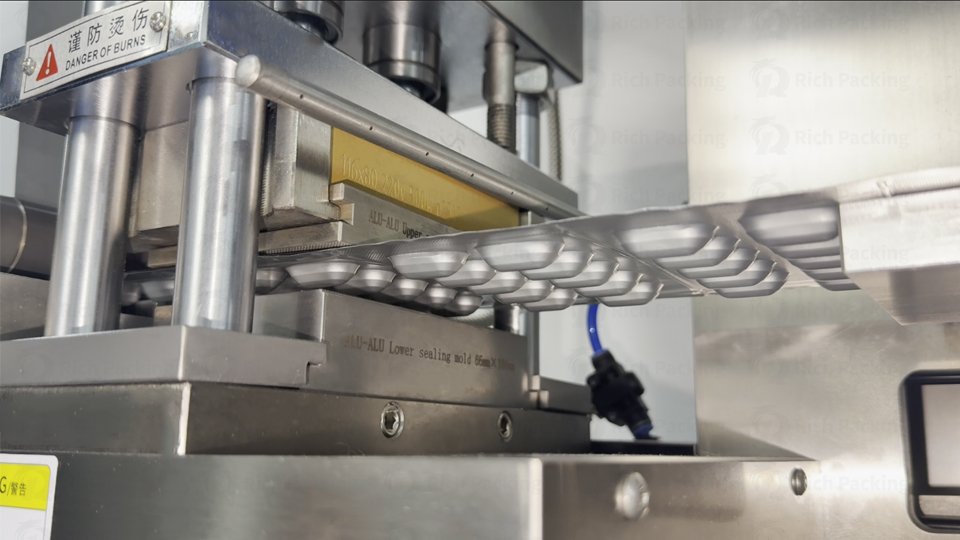
Voici le processus universel, décomposé par type de machine :
Étape 1 : Chauffage et formage
Tout d'abord, le film plastique (généralement du PVC) doit être chauffé jusqu'à un état malléable (environ 120°C–140°C) et mis en forme de poches.
Sur une machine de conditionnement sous blister manuelle : le processus est intermittent. Il faut placer manuellement le film PVC prédécoupé dans la cavité du moule. Ensuite, il faut activer manuellement le chauffage et l’air comprimé ; ces flux d’air vont donner au plastique la forme du moule.
Sur une machine de conditionnement sous blister automatique : ce processus est continu. La machine alimente automatiquement le film PVC dans le dispositif de chauffage, puis dans le dispositif de formage. Durant cette étape, de l’air comprimé ou des inserts mécaniques compriment le film en forme de bulle, tout en maintenant sa forme en mouvement.
Étape 2 : Chargement du produit
Une fois les bulles formées, le médicament doit être placé à l'intérieur.
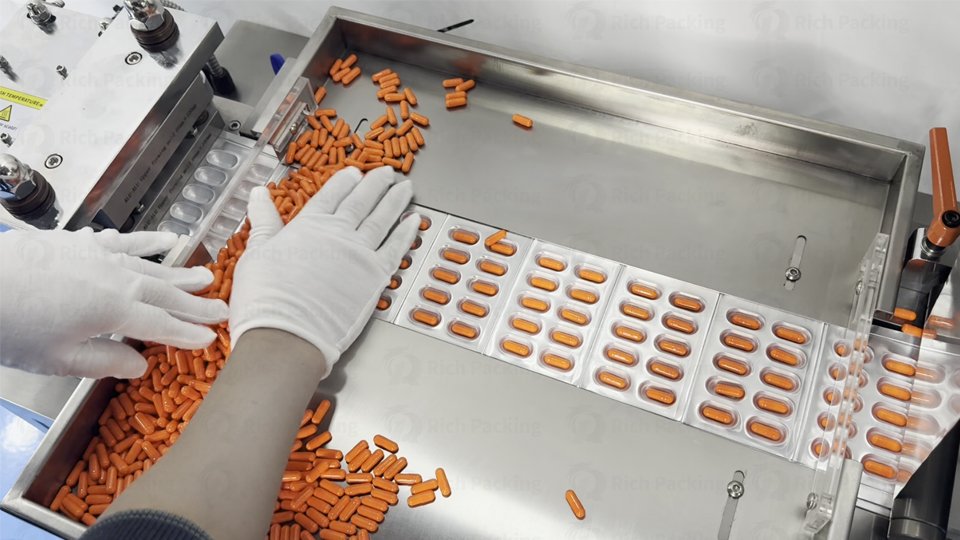
Manuel / Semi-automatique : L'opérateur place manuellement les capsules dans les alvéoles. La qualité des plaquettes thermoformées dépend entièrement de l'opérateur, ce qui engendre une baisse de productivité.
Automatique: La machine est équipée d'un distributeur qui dépose automatiquement les pilules au passage de la toile.
Étape 3 : Scellement
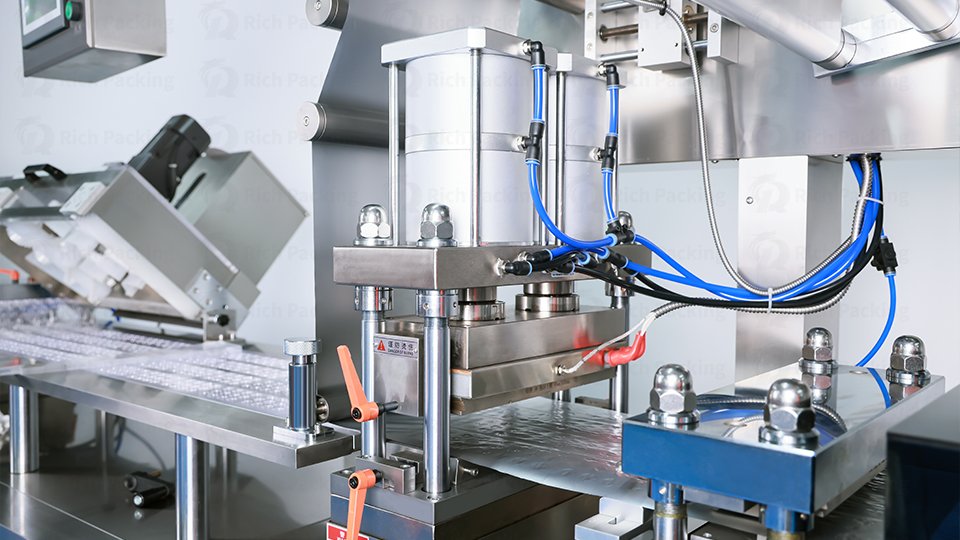
Il est maintenant temps de sceller le produit à l'intérieur avec la feuille d'aluminium.
Machine d'emballage sous blister à plaque plane (semi-automatique) : Déposez la feuille d'aluminium sur la feuille de PVC pré-remplie. La plaque chauffante supérieure descend ensuite, s'ajustant parfaitement à la plaque inférieure et scellant ainsi la feuille entière en une seule opération.
Machine rotative de scellage sous blister (automatique) : La feuille mobile se déplace entre deux rouleaux chauffants. Le scellage est instantané, les rouleaux pressant l'un contre l'autre le PVC et la feuille d'aluminium. Cette méthode est plus rapide, mais exige un contrôle précis de la température.
Étape 4 : Codage, gaufrage et découpe
La dernière étape consiste à transformer la feuille scellée en plaquettes thermoformées individuelles.
Manuel / Semi-automatique : Il faut souvent déplacer la feuille scellée vers un poste de découpe séparé ou appuyer sur un levier séparé pour perforer les cartes finales.
Automatique: La machine appose automatiquement le numéro de lot et découpe la dernière plaquette thermoformée de médicaments dans un bac de collecte, laissant les déchets être enroulés.
Précautions et conseils pour la fabrication d'emballages blister de haute qualité
Comme le montre le processus décrit ci-dessus, la fabrication d'emballages blisters impose des exigences strictes en matière de température de la machine, de dureté des lames, de précision et de pression. Même avec les machines les plus performantes, une attention particulière est nécessaire lors de leur utilisation. Vous trouverez ci-dessous quelques problèmes courants rencontrés lors de l'utilisation des machines de blisterage, ainsi que des conseils d'utilisation pour vous aider à maîtriser rapidement leur fonctionnement.
1) Pourquoi les emballages blister ont-ils des plis ?
Les plis ou un gaufrage imprécis sur les emballages blister indiquent généralement une pression insuffisante ou irrégulière. Lors du choix d'une machine à blister, privilégiez celles équipées de deux cylindres afin de garantir une pression de thermoscellage élevée et homogène.
2) Pourquoi les bords des emballages blister sont-ils rugueux et présentent-ils des bavures ?
Il s'agit d'un problème de découpe, généralement lié à l'usure des lames. Certaines machines de conditionnement sous blister utilisent des lames en acier à outils ordinaire ou en acier inoxydable, qui s'usent souvent considérablement en moins de six mois. Pour obtenir des bords de blister lisses et sans bavures, tenez compte des points suivants : Emballage riche car toutes nos machines utilisent des lames de coupe en acier allié au molybdène-chrome-vanadium à 12 % de Panasonic, qui sont résistantes aux hautes températures et à l'usure.
3) Pourquoi certains emballages de médicaments sont-ils incomplets (il manque des pilules) ?
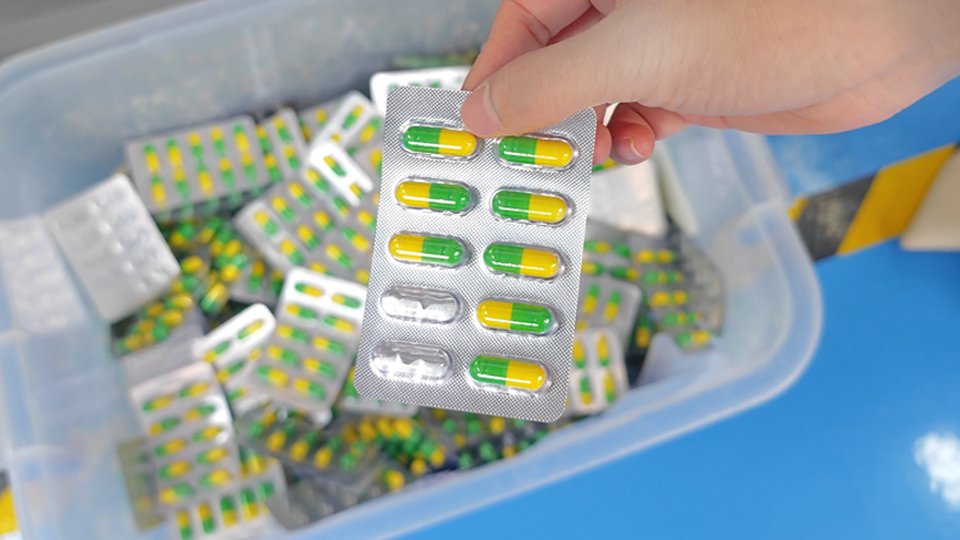
Cela est dû à un décalage entre la vitesse d'alimentation et la vitesse de convoyage des feuilles. La taille du matériau est également un facteur essentiel. Les matériaux plus volumineux sont plus sujets aux ruptures de stock, principalement parce que les machines à blisters classiques utilisent des alimentateurs à brosses, difficiles à manipuler pour les produits plus lourds ou plus grands. Rich Packing, en revanche, a innové en matière d'alimentation grâce à un système de rails de guidage, adapté à la plupart des formats standard de capsules ou de comprimés, garantissant ainsi une grande précision d'alimentation.
4. Garantir des emballages blister parfaits à long terme : Maintenance des machines d’emballage blister
Vous ne parcourriez pas 80 000 kilomètres en voiture sans vidange. De même, la réussite de la fabrication d'emballages blister repose sur un entretien rigoureux.
Vérifiez la pression de l'air Les systèmes pneumatiques assurent le formage et la découpe. En cas de chute de pression d'air, les alvéoles des comprimés seront peu profondes et mal définies.
Lubrification Toutes les pièces mobiles, en particulier les entraînements à came d'une machine d'emballage sous blister à plaque plane, nécessitent une graisse de haute qualité et de qualité alimentaire.
Étalonnage du capteur : Assurez-vous que la cellule photoélectrique qui aligne l'impression sur la feuille avec la pochette est propre et calibrée.
5. Conclusion
Félicitations ! Grâce à cet article, vous avez désormais assimilé les étapes de base du processus de production des blisters et du fonctionnement des machines. Maîtriser la fabrication des blisters est un cheminement vers l’autonomie. Si les machines de conditionnement sous blister vous intéressent, n’hésitez pas à nous contacter. Contactez Rich Packing Nous sommes toujours là pour vous !
Q1 : Pourquoi utilise-t-on couramment des plaquettes thermoformées pour les médicaments ?
Le conditionnement sous blister est actuellement la méthode d'emballage idéale pour les comprimés, car elle protège chaque comprimé jusqu'à sa consommation complète. De plus, ce type d'emballage favorise l'observance du traitement par le patient.
Q2 : Combien de temps se conservent les comprimés hors de leur plaquette thermoformée ?
Cela dépend de l'humidité ambiante et de la stabilité du médicament ; il peut se détériorer en 24 à 48 heures.
Q3 : Plaquette thermoformée vs plaquette en bandelette vs flacon : quelle est la meilleure option d’emballage pour les médicaments ?
Les flacons sont les moins chers, mais offrent la protection la plus faible une fois ouverts. Les plaquettes thermoformées sont pratiques, mais fragiles. Les sachets à bulles pour médicaments offrent le meilleur compromis : une protection rigide pour le comprimé et d’excellentes propriétés barrières.
Q4 : Les emballages blister sont-ils recyclables ?
C'est compliqué. Les emballages à bulles traditionnels en aluminium et PVC pour médicaments sont difficiles à recycler car il faut séparer l'aluminium du plastique, ce que la plupart des programmes de collecte en porte-à-porte ne permettent pas.
[1] Grand View Research : Rapport sur le marché des emballages blister pour le secteur de la santé (2026-2033). https://www.grandviewresearch.com/industry-analysis/healthcare-blister-packaging-market-report .
[2] Mordor Intelligence : Marché des emballages sous blister pharmaceutiques (prévisions 2026).
[3] Vicki S Conn et al. : Interventions d'emballage pour augmenter l'observance médicamenteuse : revue systématique et méta-analyse. PMC (Curr Med Res Opin).

29+ years in pharmaceutical machinery, covering capsule filling, tablet pressing, blister packaging, tablet and capsule counting, cartoning, GMP production, and overseas machine service.

E-mail : manager@richpacking.cn
Building D, No. 226, Beishan Qiaotou Street, Haizhu District, Guangzhou City, Guangdong Province, China


 Réseau IPv6 pris en charge